
Projects
Smart Streetscapes: Situational Awareness
November 2026–present, Columbia University
- I contribute to the situational awareness research thrust at the NSF Center for Smart Streetscapes. The team studies how to recognize activities and anticipate movement when cameras see only part of an intersection.
- Situational awareness research
More project updates to come.
LLM-Driven Travel Behavior Modeling: RAG for Predicting Trip Dynamics
2025–2026, The University of Texas at Austin
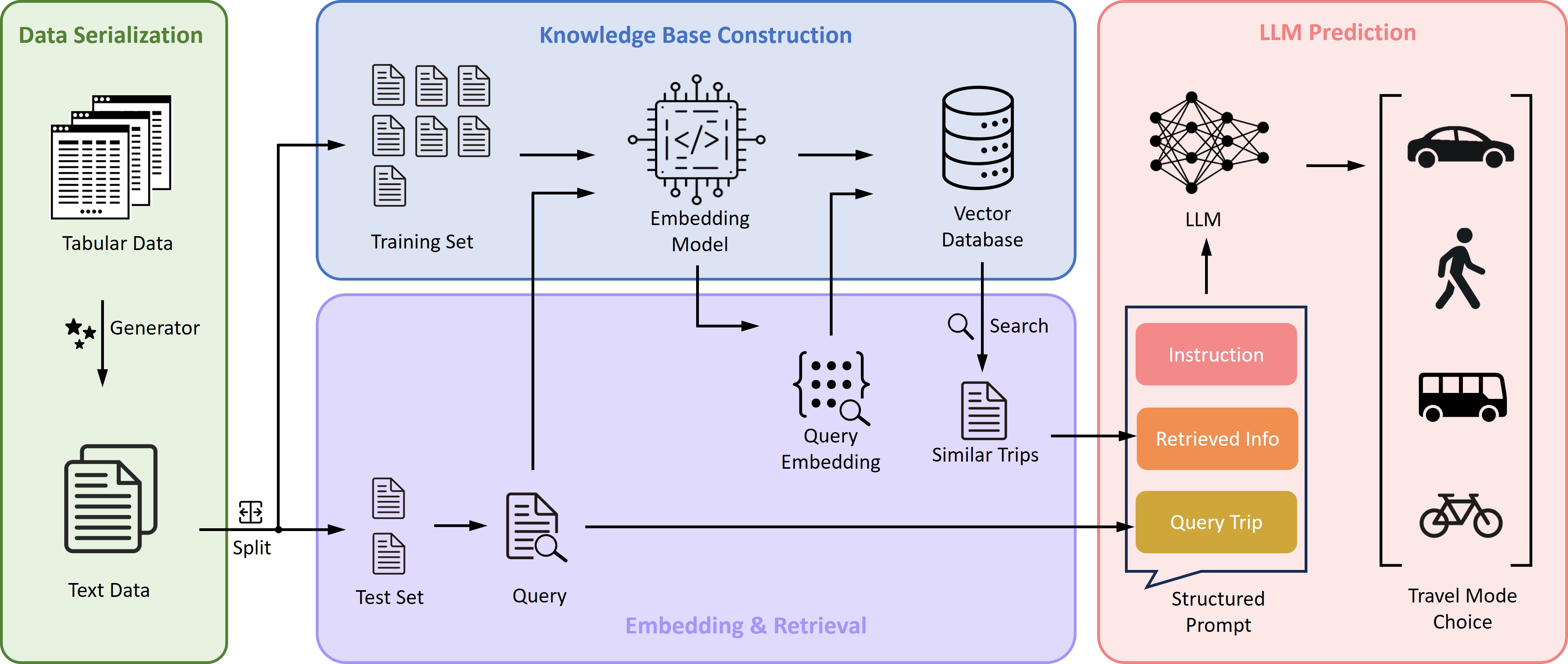
- Developed a modular framework for integrating RAG into LLM-based travel mode choice prediction.
- Evaluated four retrieval strategies across three language models.
- Retrieval improved predictive accuracy across models. Read the study.
LLM-Agent for SUMO Simulation
2025–2026, The University of Texas at Austin
- LLM-powered, web-based transportation simulation platform that integrates SUMO with the OpenAI Agents SDK and the Model Context Protocol (MCP).
- Enables natural language interaction, dynamic scenario editing, and AI-assisted decision support.
- Allows users to conversationally specify simulation tasks and control the simulation. Source code.
Autonomous Vehicle Accidents Analysis
Started September 2024, The University of Texas at Austin
- Utilized LLMs (GPT-4o) via the OpenAI API to extract key insights from autonomous vehicle (AV) accident reports.
- Conducted spatiotemporal analysis of AV accidents to identify trends and inform management strategies.
- Developed a Random Forest (RF) model to investigate factors contributing to crash severity. California autonomous vehicle collisions dataset.
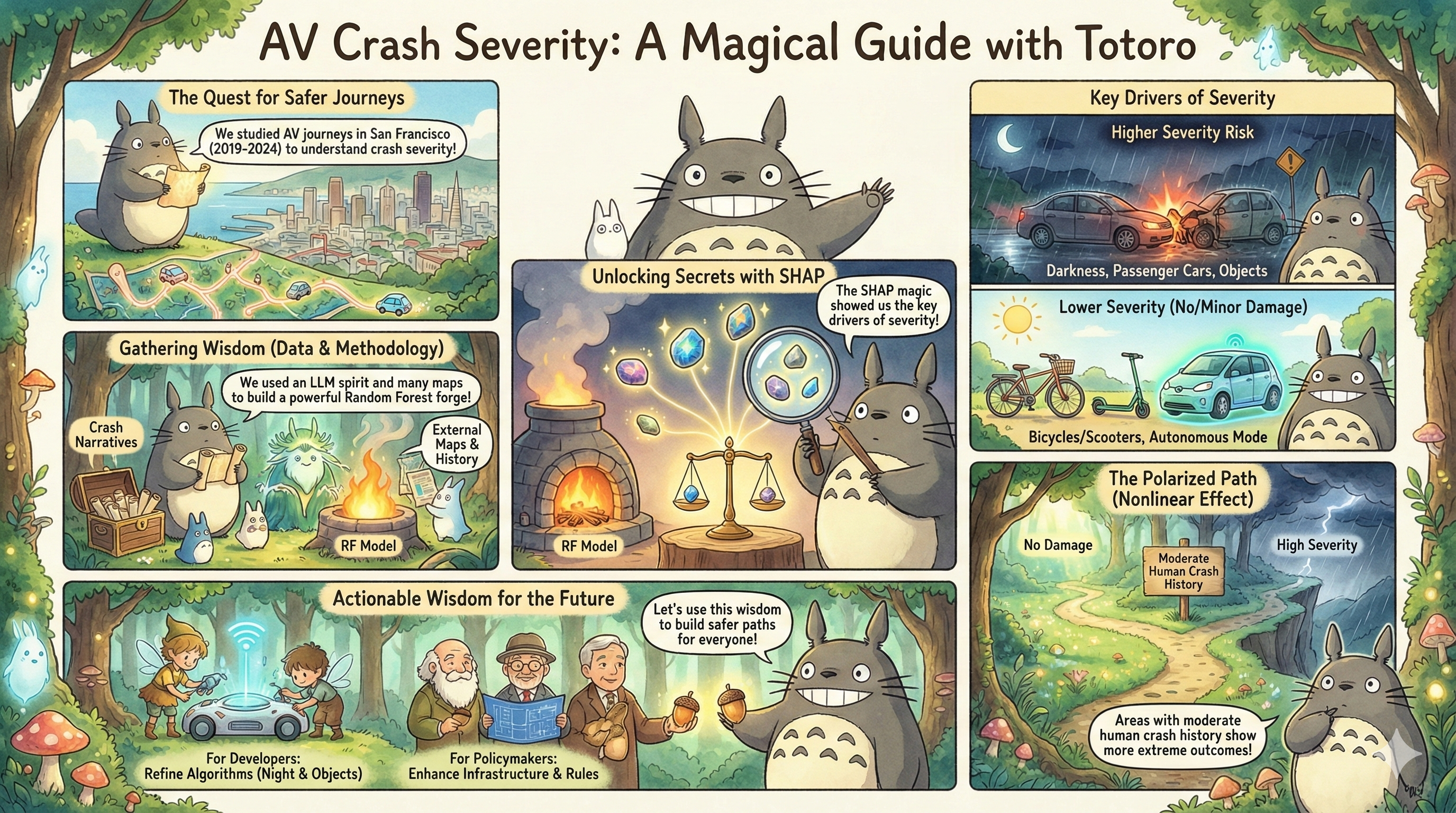
(Generated by Google Gemini)
Electric Vehicle Safety and Crash Pattern Analysis
Mar 2024 - June 2025, The University of Texas at Austin
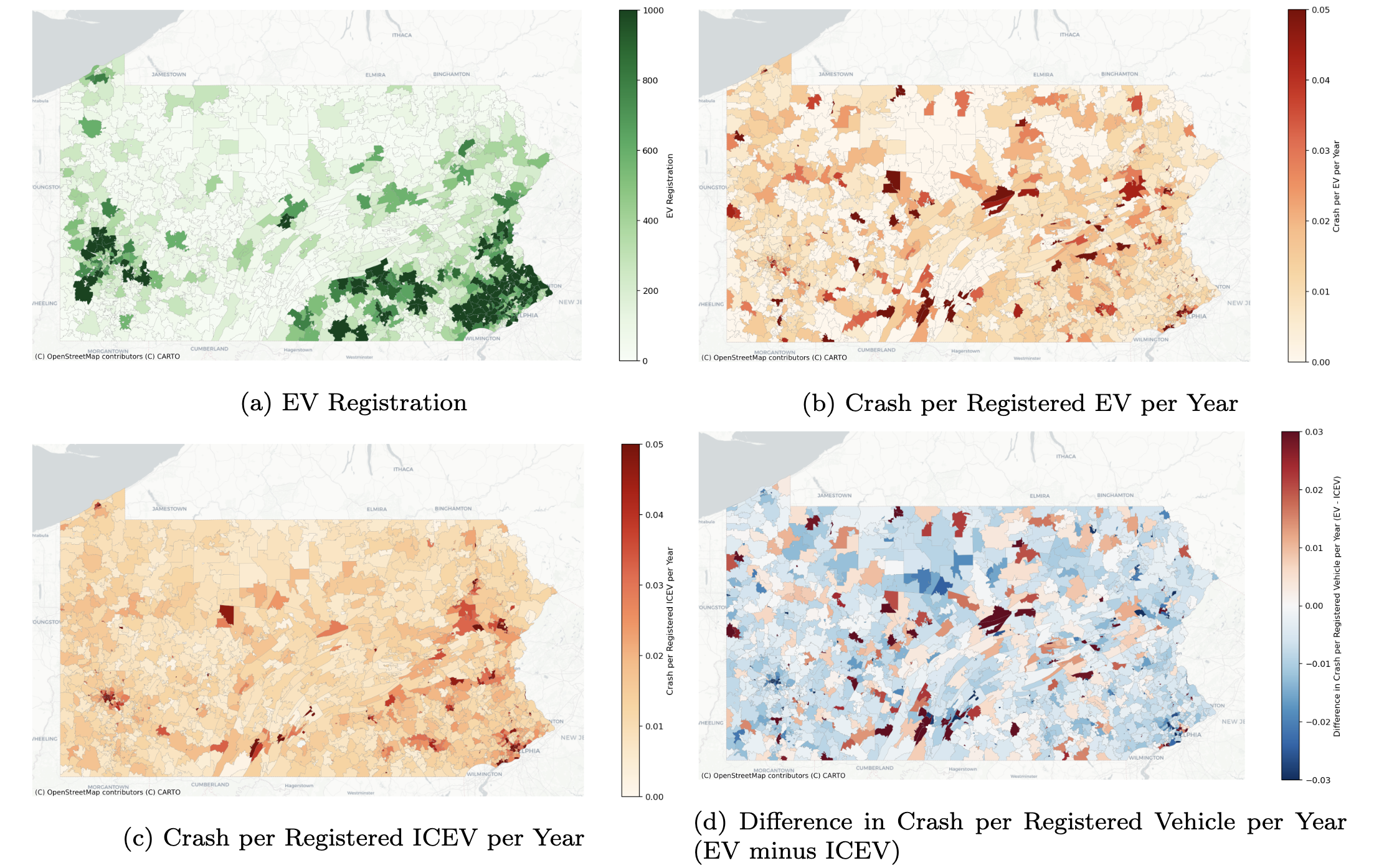
- Compared the spatiotemporal distribution, crash severity, and contributing factors between EV-involved crashes and other crashes.
- Developed an ordered logistic regression model to assess the impact of environmental, geographical, and human behavioral factors on EV crash severity.
Omniverse Isaac Sim and SUMO Co-Simulation
May 2025 - Sep 2025, The University of Texas at Austin
LLM for Emergency Preparedness
2024 - 2025, The University of Texas at Austin
Funded by City of Austin
Collaborator: Moody College of Communication at The University of Texas at Austin
- Gathered corpus data through web scraping and inputting official documents.
- Fine-tuned an LLM model (LLaMA) on millions of QA pairs extracted from the City of Austin and government data.
- Developed a chatbot based on the fine-tuned LLM, complemented with a user-friendly web interface.
- Integrated multi-language chat functionality into the chatbot.
Digital Twin as Catalyst for Sustainable and Smart City
Aug 2023 - Dec 2024, The University of Texas at Austin
Partially funded by Center for Smart Transportation (CST), a Tier 1 University Transportation Center
Collaborator: DELL, MarkIII, NVIDIA
- Developed a web-based platform for real-time urban data publication and visualization, including transit, micromobility, traffic conditions and incidents, accessibility, and emergency.
- Created a 3D city model for Austin, TX on the Nvidia Omniverse platform. Visualized the city dynamics in 3D.
- Constructed an urban simulation model incorporating transportation, air pollution, noise, and facilities for Austin, TX.
Warehouse Digital Twin for Manufacturing Robot Simulation
Jun 2024 - Dec 2024, The University of Texas at Austin
Collaborator: DELL
Electric Vehicle Charging Accessibility Analysis
Feb 2024 - June 2025, The University of Texas at Austin
- Calculated accessibility measures for public electric vehicle charging stations in Austin, TX, and analyzed disparities.
- Assessed accessibility inequality using the Lorenz Curve, Gini Coefficient, Theil Index, Palma Ratio, and Segplot, and accessibility poverty through needs-gap analyses and FGT scores.
- Investigated egalitarian and sufficitarian philosophies in federal EV infrastructure programs, identifying misalignments in equity-focused policies.
Evolution of E-scooter Sharing in Austin, TX
Sep 2023 - Dec 2024, The University of Texas at Austin
- Developed a Random Forest (RF) model to analyze the influence of built environment and demographic variables on shared e-scooter usage in Austin, TX.
- Assessed the non-linear effects of variables on shared e-scooter trip frequency using Partial Dependence Plots (PDP).
- Explored the spatial heterogeneity of e-scooter’s relationship with ridesourcing trips using the model interpretation method, Shapley Additive Explanations (SHAP).
Real-Time Traffic Monitoring Using Transit Buses as Probes
July 2023 - Dec 2023, University of Florida
- Identified the distinct operational on/off-boarding events of bus fleets and estimated the average traffic speed for each road segment using GTFS Realtime data.
- Validated the estimated traffic speed using other data sources including Bluetooth and Google Maps data.
Shared Micromobility Demand Forecasting with Deep Learning
Jan 2021 - Aug 2023, University of Florida
- Formulated a novel spatiotemporal model using a Convolutional Neural Network (CNN) and interactive learning mechanisms to predict demand trends in shared micromobility services.
- Developed a deep learning framework using Transformer and Graph Convolutional Network (GCN) to forecast travel demand for dockless scooter-sharing systems.
- Applied the proposed models on real-world datasets in Washington, D.C., Austin, TX, and Chicago, IL. The proposed models achieved over 25% improvement in prediction accuracy compared with benchmark models.
Evacuation Behavior Analysis using Large-Scale GPS Data
2020 - 2022, University of Florida
- Developed methods to infer and analyze the evacuation behavior (i.e., evacuation decision, destination, route choice) of residents during wildfire events using large-scale GPS data. Kincade Fire evacuation routes.
- Explored key factors associated with residents’ evacuation decisions and their effects on evacuation compliance rate in Sonoma County, CA during the 2019 Kincade Fire.
- Developed a deep learning model that incorporates Graph Convolutional Network (GCN) and Gated Recurrent Unit (GRU) to forecast spatiotemporal trip generation during wildfire evacuation.
Micromobility as a Solution to Reduce Urban Traffic Congestion
Mar 2020 - Aug 2021, University of Florida
- Scraped real-time micromobility services data and developed algorithms to infer micromobility trip origins and destinations based on real-time system status data.
- Analyzed the spatial and temporal usage patterns of shared micromobility services in Washington, D.C.
- Investigated factors associated with shared micromobility usage, providing insights to aid policymakers’ decisions.
Interpretable Machine Learning on the Adoption of Ride-Splitting
Aug 2019 - Feb 2021, University of Florida
- Modeled ridesourcing users’ adoption of ride-splitting services in Chicago using the Random Forest (RF) model.
- Identified key factors associated with model outcomes using Variable Importance.
- Analyzed nonlinear relationships between factors and outcomes using model interpretation methods, including Partial Dependence Plot and Accumulated Local Effects.
- Explored how understanding nonlinear patterns can assist professionals in managing and promoting ride-sharing.
Evaluation for Autonomous Vehicle Safety
Dec 2017 - Mar 2019, Tongji University
- Extracted critical driving scenarios from Shanghai naturalistic driving data for autonomous vehicle safety testing.
- Proposed an accelerated testing scheme for autonomous vehicle safety evaluation using the importance sampling technique. Achieved over 30 times acceleration compared with the Monte Carlo method.
- Designed a software-in-the-loop testing platform for autonomous vehicle testing based on the proposed test scheme.
Vehicle Turning Behavior Modeling at Mixed-Flow Intersections
Aug 2016 - Sep 2018, Tongji University
- Developed a quasi-two-dimensional model based on potential field theory to predict trajectories of turning vehicles.
- Evaluated the proposed model by reproducing trajectories of left-turn vehicles at a mixed-flow intersection in Shanghai.
Vehicle Cooperation Around Lane-Changing
Jun 2018 - Aug 2018, University of Massachusetts Lowell
- Identified lane-changing scenarios and extracted vehicle trajectories in lane-changing scenarios using NGSIM data.
- Explored vehicle cooperation before, during, and after lane-changing. Characterized and categorized cooperative lane-changing based on the behaviors of leading, ego, and following vehicles.